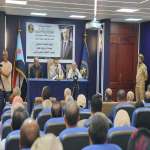
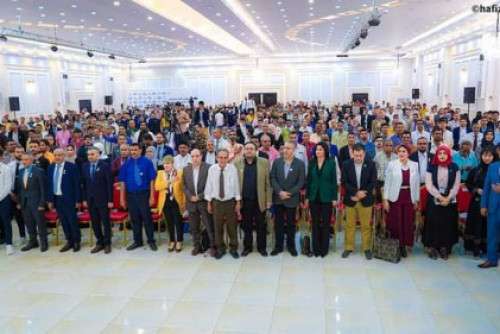
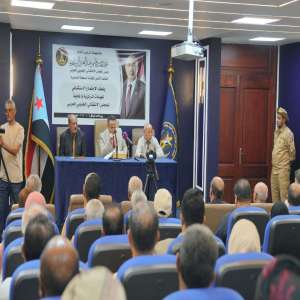
On the sidelines of the first conference of southern journalists and media professionals, which resulted in the restoration of their confiscated syndicate since the ill-fated union in 1990, the participation and attendance of the international delegation had a special impetus, and a program of field visits and various important meetings was prepared.
The members of the delegation affirmed that their visit to the capital, Aden, contributed to changing the misconception about the situation in Aden, as well as about the Southern Transitional Council, explaining that they sought openness from the Southern Transitional Council to all political forces and opinions, and that Aden is more secure than what is portrayed in the media, as they found that there is a safe and stable environment, contrary to what is being promoted by many media outlets.
Security, Safety, Determination and People Will:
The visiting delegation met Lawyer Niran Suqi, member of the Presidium of the Southern Transitional Council, deputy chairperson of the National Assembly, and Dr. Anis Luqman, deputy chairperson of the National Assembly, who in turn presented a brief picture of the establishment of the National Assembly, the activities of its permanent committees, and its sessions.
They emphasized that Aden now enjoys safety and security, and the visit of the delegation is an evidence of that. Suqi wished the delegation members a pleasant stay in Aden, pointing to the necessity and importance of joint coordination between Arab and foreign journalists and southern journalists.
Mr. Fadl Muhammad Al-Jaadi, member of the Presidium of the Southern Transitional Council, Deputy Secretary-General of the General Secretariat of the Presidium of the Council, during his meeting with the Arab media delegation, gave a brief explanation about the issue of the people of the south and the advantages and status of the southern state whose people made concessions for the sake of unity on the path of Arab unity, and what They were subjected to exclusion and marginalization, followed by the war of occupation of the south in 1994, the results of which were the looting and destruction of private and public property.
Professor Al-Jaadi affirmed the determination of the people of the south and their continuation in restoring their state and all their legitimate rights and building the southern state that will be with its entire people, and work with brothers in the coalition countries to support the Arab project, combat terrorism and confront all internal and external projects against that.
Media tour:
Mr. Abdul Aziz Al-Sheikh, Head of the Radio and Television Sector, received the delegation of Arab and foreign journalists and media professionals participating in the conference of southern journalists and media professionals during his visit to the building of the independent Aden Channel and Radio Hona Aden, presenting the delegation a briefing of the establishment of the channel and the radio.
Al-Sheikh expressed his aspiration to enhance cooperation in the media field between the sector and various Arab and international media expertise, and to benefit from their services and expertise in this field.
The delegation toured the departments and sections of the independent Aden Channel and Radio Hona Aden, acquainted with the work of the sector's departments, staff and studios, praising the sector's capabilities, the energy of the youth working in it, the inclusion of the female element, the channel's activity and its role in championing homeland issues, combating terrorism and counter projects.
Southern Independence:
The Jordanian journalist, Omar Al-Maharmeh, editor-in-chief of the Jordanian Al-Dustour newspaper, confirmed that the Arab south is a big issue for people who have lived through injustice, marginalization, and plundering their capabilities for many years. Because one day it drifted behind the Arabs' dream of unity, so it accomplished unity with Yemen before social, intellectual and political forces realized that their country was united by passion without laying solid rules that would make them partners in one state, so they were subjected to all kinds of oppression and injustice, plundering of resources and sowing seeds of sedition, and eliminating all their urban achievements, and when they tried to restore their right they were subjected to a process of repression that claimed the lives of tens of thousands of martyrs.
In his impression of his visit to Aden, Al-Maharmeh said: "Some - including myself - believe that Yemen in 1990 returned as one country as it was in previous decades or centuries, but I discovered that Yemen is a geographical region like Al-Maghreb or Levant, but it differs from them in that it was not historically, not in any period of one state, but it was divided into the north, where the state of Imamate was before the proclamation of the Yemen Arab Republic, and sheikhdoms and sultans in the south before it unified in 1962 under the name of Democratic Republic of Yemen, which was one of the progressive models affected by the weakness and fall of the Soviet Union.
He added, "In short, and for many of the reasons I heard, I find myself with the independence of the south - independence, not separation - and the restoration of its right to its own state and self-determination, although I never imagined that I would support any idea of fragmenting the fragmented part of our Arab world."
Inspect the Sick and Visit the Displaced:
The foreign delegation was briefed on the conditions of patients in Al-Sadaqa General Hospital in the capital, Aden, to submit a detailed report to the international press. They were received by Dr. Yasser Al-Wali, Acting Director General of the hospital, and Dr. Aref Al-Daari, Director of Medical Insurance for the Southern Armed Forces.
The delegation inspected the work of the center and the suffering of oncology patients coming for treatment, the extent of the increase in sick cases that come daily to receive treatment at the center, and the malnutrition and newborn departments, and heard from the department's doctor about the cases that the hospital receives from all the districts of Aden and the neighboring governorates.
Abboud Naji Hussein, Director General of Dar Saad District, put the delegation during their visit to the camp for the displaced in Ammar bin Yasser High School, before the difficulties facing the district as a result of the continuous displacement to it and to government and educational facilities.
Hussein stressed the need to find an alternative place for the displaced, in light of the district's need for an educational facility due to the absence of any nearby schools in the area, which caused hardship for female students as a result of their going to a far high school from the area.
The Director General of the district gave a detailed explanation to the delegation about the impact of the waves of displacement in the district on health and educational services in various aspects of life, calling for the provision of alternative sites for the gatherings of the displaced in light of their different habits from the people.
Crowning sacrifices and changing the misconception:
Sonia Al-Zaghoul, the announcer on Akhbar Al-Aan channel, expressed her happiness at participating in the conference and visiting the city of Aden, and said in a statement to the independent Aden TV: "We are proud to participate in the conference, which culminated in the selection of a syndicate that preserves the rights of journalists, sacrifices to protect your Arab surroundings, and your land from the Persian-Iranian tide, and my work to monitor efforts of combating terrorism in the south was only a drop in the sea of your great giving.
The international delegation, which participated in the activities of the first conference of southern journalists and media professionals, which was held last week in Aden, visited the foreign affairs building of the Transitional Council. During the visit, they listened to a brief explanation of the political road map of the Southern Transitional Council internally and externally, the efforts of the Southern National Dialogue at home and abroad, the political vision for comprehensive peace adopted by the Transitional Council, and the emphasis that the Southern Transitional Council establishes a federal southern state that is characterized by the spirit of the times and respects partnership, democracy and dialogue. In addition, human rights, freedoms, reject violence, extremism and hatred, and that the next southern state will be an important tributary of peace and regional and international stability.